Unboxing Videos in 2026: Making the Reveal Worth Waiting For
Unboxing video ideas for TikTok that hold: promise the payoff in frame one, let sound and hands carry it, cut the dead packaging time, keep the first reaction honest.

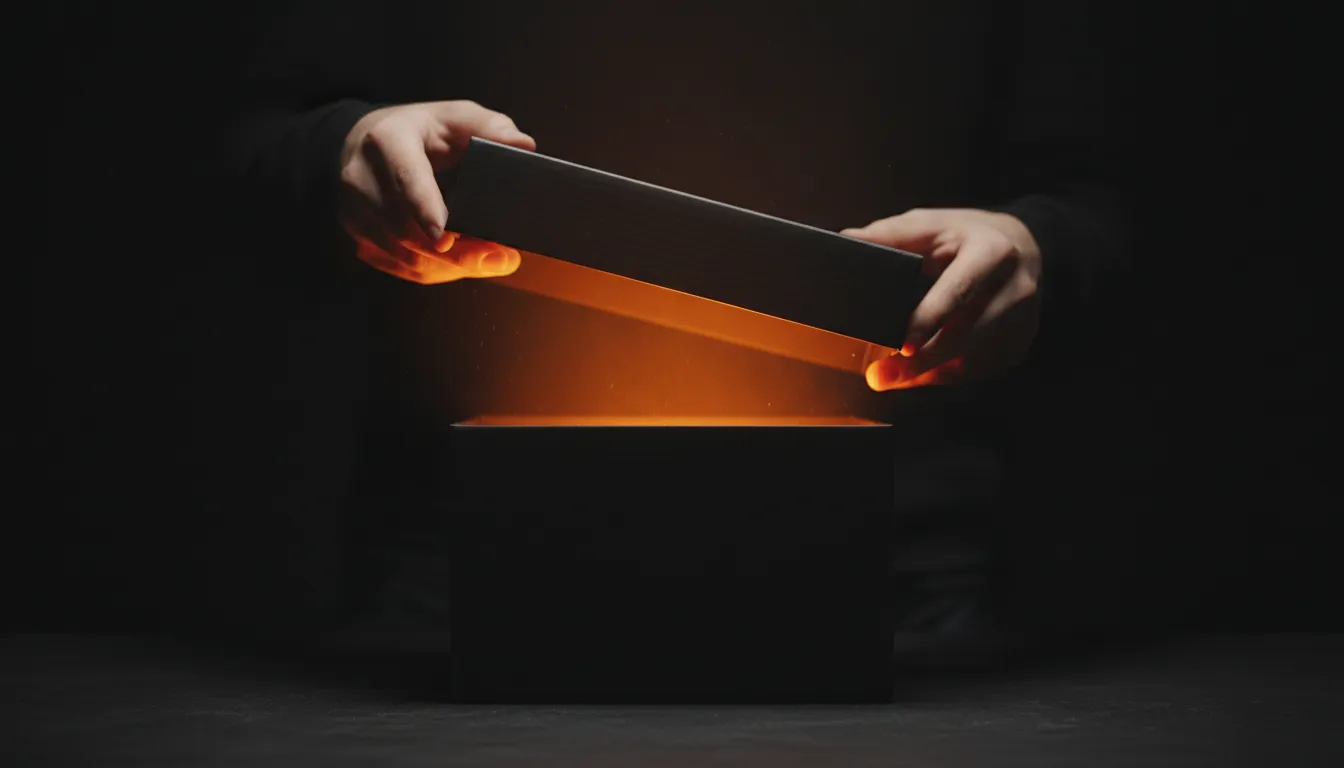
Nobody watches an unboxing video for the box. They watch for the half second when the thing inside is finally visible, and every second you spend on tape, plastic and tissue paper is a second you are asking them to wait for that moment without telling them it is worth it.
Here is the short answer to what you searched. Unboxing videos hold when the first frame promises the payoff, the sound and the hands do the talking, the dead packaging time is cut to almost nothing, and the first reaction is the real one. The product matters less than you think. The structure of the wait is the content.
If you have read our breakdown of how to structure a product review video, this is its younger sibling. A review sells a verdict. An unboxing sells a reveal, and a reveal lives or dies on pacing.
Why unboxings still work
The format is older than short video, and it keeps coming back for one reason: it is a curiosity gap with a guaranteed answer. The viewer knows something is inside, they do not know exactly what it looks like, and they know they will find out. That is a contract. Most hooks make a promise they might not keep. An unboxing makes a promise the format itself guarantees.
The problem is that the guarantee makes creators lazy about the middle. Because the reveal is coming anyway, the opening drifts: a long shot of the sealed box, a sentence about where it came from, a slow peel of the shipping label. When we look at unboxing videos in our library of analyzed videos, the ones that sag tend to share that shape. The reveal arrives late, and nothing between the first frame and the reveal tells the viewer why they should wait.
Frame one: promise the payoff
Your hook is not “look what came in the mail.” It is a reason to care about what is inside, shown or said in the first second.
Ways to do that without spoiling the reveal:
- Show a sliver of the product. A corner, a color, a texture through the cutout. Enough to start the guessing game, not enough to end it.
- Say the stake. “This is the one everyone said would sell out” or “I waited four months for this” tells the viewer the reveal has a history.
- Lead with the verdict, hold the visual. “This is either the best thing I bought this year or a total waste” turns the unbox into a test.
- Start inside the action. Open with the lid already lifting. We made the general case for skipping the warm-up in cold opens with no intro.
What does not work: the sealed box on a table with nothing happening. A closed box is a still image, and a still image in the first second reads as a frozen video.
The cover frame is part of the promise
On profile grids and in search, your cover is the first frame most people see. An unboxing cover that shows the product fully revealed spends the payoff before the video starts. Show the moment just before: hands on the lid, the product half out of its sleeve. We go deeper on this in the cover frame as a second hook.
Let sound and hands carry it
In an unboxing, the hands are the presenter. Viewers read their speed, their care, and their hesitation as emotion. Slow, deliberate hands say “this is precious.” Fast, eager hands say “I cannot wait either.” Both work. Fumbling hands that are only there to get the box open do not.
Sound is the other half. The rip of a pull tab, the snap of a magnetic lid, the crinkle of tissue, the click of a product settling into its tray: these small sounds are a big part of why people finish unboxings with the volume up. A few practical rules:
- Record clean audio close to the box. A phone mic a meter away picks up the room, not the snap.
- Keep your voice from talking over the best sound. If the lid makes a great noise, stop talking for it.
- Keep music low or out. A loud track flattens every texture you filmed. If the sounds are the best part, the music should sit well under them or not be there at all.
Some unboxings lean all the way into sound and drop the voice entirely. That is closer to an ASMR format, and it works best when the packaging itself is interesting to hear.
Cut the dead packaging time
This is where most unboxings lose people. Shipping boxes, outer sleeves, plastic wrap, twist ties, foam inserts: every layer is a delay, and only some of them are interesting.
A useful test for each layer: does this layer make the reveal feel bigger, or just later?
- Keep the layer that builds anticipation. A beautiful inner box, a reveal-under-tissue moment, a product that slides out of a sleeve. These earn their time.
- Compress the layers that are only logistics. The shipping carton, the tape, the bubble wrap. One fast cut or a jump past them entirely.
- Never show a struggle unless it is the joke. Ten seconds of wrestling with a blister pack is only content if the struggle is the point of the video.
In practice, a lot of strong unboxings move from “box in hand” to “product visible” in a handful of seconds. If your reveal sits past the midpoint of the video, most of the audience never reaches it.
Speed ramps over slow-motion
A quick speed ramp through the boring layers keeps the motion alive without lying about what happened. Slow-motion on the reveal itself can work once. Slow-motion on the shipping carton is a stall.
Keep the first reaction honest
The reveal is half the payoff. The other half is your face or voice in the second after it. Viewers can tell a rehearsed “oh my god” from a real one, and a fake reaction to a product they might buy costs you the one thing an unboxing trades on: trust.
What an honest first reaction looks like:
- Say the first true thing. “It is smaller than I expected” is more useful, and more watchable, than “it is perfect.”
- React to the detail, not the whole. Point at the stitching, the weight, the screen brightness. Specifics read as real.
- Leave a beat of silence. The half second where you are just looking at it is the shot people rewatch.
- Flag a disappointment if there is one. A small honest negative makes every positive after it more believable. We cover this in the product review structure post too.
If the product was sent to you, say so on screen. Platforms require disclosure for paid or gifted content, and viewers trust a labeled unboxing more than one they later find out was sponsored.
After the reveal: earn the save
Once the product is out, the viewer’s question changes from “what is it?” to “should I get one?” Give them one or two things that answer that, and stop.
- One close detail they could not see in a product photo. The texture, the real size next to your hand, the sound it makes when it turns on.
- One sentence of context. The price, who it is for, or what it replaces.
- A clean ending. Close on the product in its best light or on your one-line verdict. If you want the save, give them a reason to come back to it, which is the subject of earning the save with your closing line.
Resist the urge to do a full review here. The unboxing is the first impression. If the product deserves a deeper look, that is a second video, and a good unboxing is exactly what makes people want it.
A simple unboxing structure to start from
If you want a template to test against, here is one that fits most short unboxings:
- Second 0 to 1: the stake or a sliver of the product, with hands already moving.
- Next few seconds: compressed packaging, one layer kept for anticipation, clean close-up sound.
- The reveal: product fully visible, a beat of silence, your first honest line.
- After the reveal: one close detail, one sentence of context.
- The end: product in its best frame or your verdict, no outro.
Then change one thing at a time. Move the reveal earlier, cut a packaging layer, drop the music, and compare. Unboxings are a great format for small tests because the structure is so consistent from video to video.
How Blossom helps with unboxings
When you paste an unboxing into Blossom, the analysis tells you how strong your opening is, scores your hook from 1 to 10 and explains why, and maps where attention builds and where it drops, with timestamps. For unboxings that last part is the useful one: if the drop lands on your shipping carton, you know which layer to cut.
You can also look at how unboxing videos in your niche are structured across our library of analyzed videos, so you are comparing your reveal timing against content that already held, not against a guess. Blossom does not predict views, and it will not make an average product exciting. It tells you where your structure is spending the viewer’s patience.
The reveal is the reason people watch. Your job is to make the wait for it feel like part of the show.
Read next
Best viral.app Alternatives in 2026 (Free & Paid)
Five real viral.app alternatives, free and paid, compared on one question: does the tool score your hook and tell you why it works? Checked 26 Oct 2026.
Why Specific Hooks Beat Vague Ones (and How to Sharpen Yours)
Specific hook examples for TikTok: why a number, place or stake in the first line holds viewers a vague promise loses, and how to rewrite a soft hook three ways.
Blossom vs Iconosquare: Post Types vs a Name for the Video's Shape
Iconosquare vs Blossom: Iconosquare compares Reels, carousels and posts. Blossom names the structure inside each video, so a winning shape becomes repeatable.