Get Ready With Me Videos: Why They Work When the Talk Has a Point
GRWM TikTok ideas work when the routine is background and the story is the content. Here is how to pick the point, pace the hands, and avoid the stall.

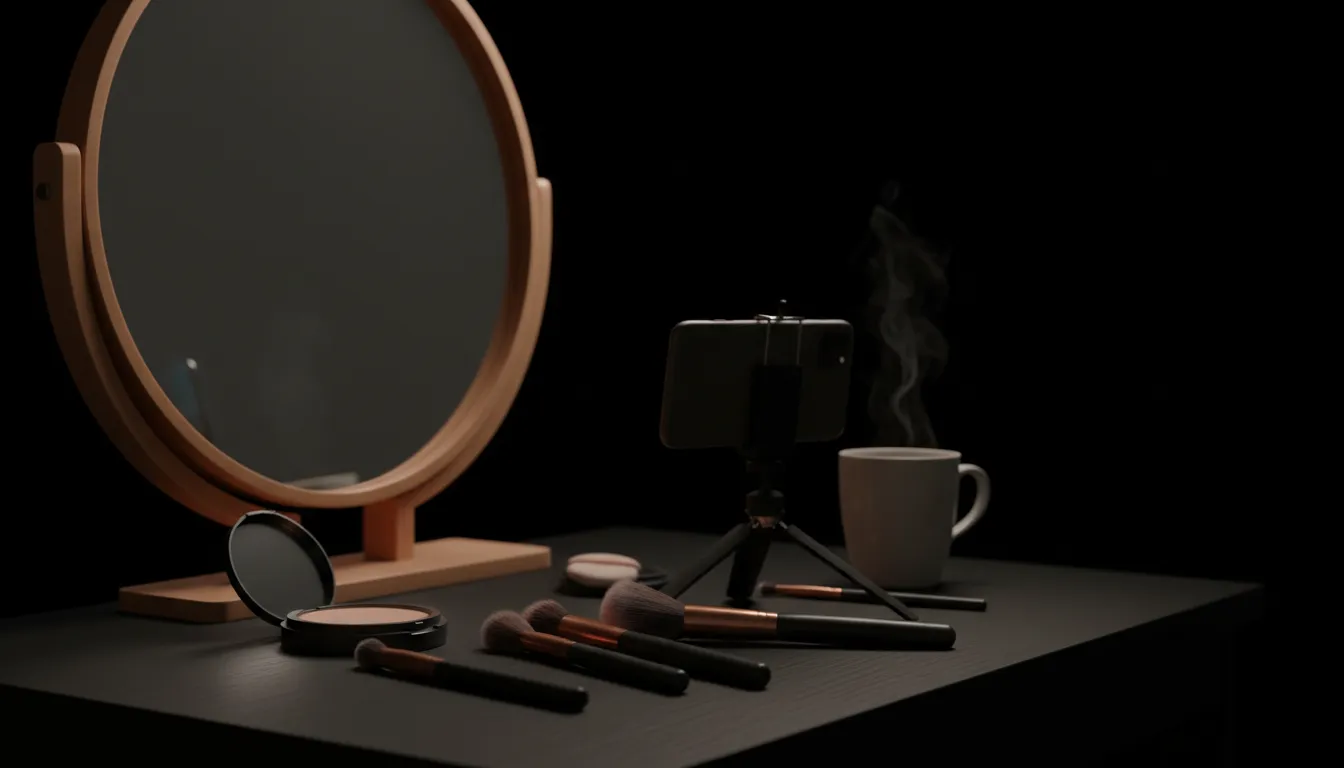
Nobody stays for the foundation. In a get ready with me video, the makeup, the outfit and the hair are almost never the reason a viewer reaches the last second. They are the reason the viewer’s eyes have something to do while the real content, the story or the opinion, does the work.
Here is the short answer to what you searched. A GRWM video holds attention when the routine is the background and the talk is the foreground: one story, one opinion, or one question, told while your hands keep moving. The routine buys you patience. The talk spends it. The rest of this post covers how to choose what to talk about, how to pace the routine so it never stalls, and where the format quietly stops working.
Why GRWM works at all
Most short-form formats fight for attention with cuts, text and payoff. GRWM does something different. It gives the viewer a low-effort visual task (watching a face change, an outfit come together) and pairs it with a voice that feels like a friend talking from the next room.
That pairing does two jobs at once:
- The routine creates progress. Every step is visibly closer to “ready”. The viewer knows the video is going somewhere, even if they could not say where.
- The talk creates a reason to stay. A story with stakes, or an opinion the viewer wants to argue with, gives them something to wait for that the routine alone cannot.
When both are present, the format is unusually forgiving. Viewers will sit through a forty-second GRWM that they would skip at eight seconds if it were the same story told to a static camera. When only one is present, the format collapses into either a silent tutorial or a talking head with props.
The routine is background, the talk is the content
The most common mistake in GRWM is treating the routine as the subject. “Today I’m using this primer, then this concealer, then…” is a tutorial wearing a GRWM costume. Tutorials can do well, but they are a different format with a different job: the viewer is there to learn the steps, and the steps have to be clear, close and well lit.
A GRWM viewer is there for you, or more precisely, for what you are about to say. That changes what the opening line should be. Compare:
- “Get ready with me for a work event.” This is a label, not a hook. It tells the viewer what is happening, not why they should care.
- “Get ready with me while I tell you why I almost quit this job on my first day.” Now there is a question, and the routine becomes the clock the story runs against.
The test is the same one we use on any hook: can a stranger say what they are waiting for after the first two seconds? If the answer is “to see the final look”, the video has to deliver a striking look. If the answer is “to hear how the story ends”, the routine can be ordinary and the video still holds. If you want to pressure-test that opening line, the frameworks in Visual vs Verbal Hooks apply directly, because GRWM nearly always leads with the verbal hook and lets the visual carry the middle.
Picking the point: three reliable shapes
Not every thought is GRWM material. The talk needs a shape that rewards staying to the end. Three shapes come up again and again in the GRWM videos in our library that hold attention best.
1. The storytime with stakes
A story where something was at risk: a date that went wrong, a boss who said something unexpected, a mistake that cost money. The routine runs underneath it and the final look lands at roughly the same time as the punchline.
What makes it work is that the stakes are stated before the setup. “I got uninvited from my best friend’s wedding” in the first line, then the backstory. Storytime that starts with “So, a few weeks ago…” makes the viewer wait for a reason to care, and most will not.
2. The opinion with a position
A take the viewer can agree or disagree with: a product you think is overrated, a trend you are tired of, an industry habit you think is wrong. This is where GRWM earns comments, because the viewer has time during the routine to form a reply.
The opinion has to be specific. “I think people spend too much on skincare” is a shrug. “I think a $9 moisturiser beats the $80 one I used for three years, and here is the one thing that changed my mind” is a position someone can push back on.
3. The answer to a question you were asked
“Someone asked me how I paid off my student loans in two years, so get ready with me while I explain.” This is the most dependable shape for creators who teach, because the question frames the value up front and the routine makes a list of tips feel like a conversation instead of a lecture.
Whichever shape you pick, the rule is one point per video. A GRWM that tells a story, then gives an opinion, then answers a question is three half-videos. Split them, and you have a series instead of a ramble.
Pacing so the hands keep moving
GRWM’s biggest technical risk is the stall: a stretch where the talk is landing an important beat but the hands are doing nothing new. The eye has no work, the ear is asked to carry everything, and that is exactly where viewers swipe.
Keep a visible change every few seconds
Each step of the routine is a small visual event. Lay them out so a new one starts every two to four seconds. If a step takes a long time in real life (blending, curling a full head of hair), cut it down. The viewer needs evidence of progress, not the full duration.
Match the big beats to the big steps
The moments where the story turns, or the opinion lands, should line up with visually distinct steps: the lipstick, the outfit reveal, the jacket going on. The visual change punctuates the line. A punchline delivered while you are dabbing concealer is a punchline delivered into a void.
Save the finished look for the resolution
The final look is the routine’s payoff, and it should land with the story’s payoff. Reveal it early and the visual thread is over while the verbal one still has thirty seconds to go. Hold it to the end and both threads close together, which is what makes the video feel finished rather than abandoned.
Watch the length honestly
Most GRWM videos that hold attention sit between thirty and sixty seconds. Longer works only when the story keeps adding information. If your edit runs past a minute, read The Mid-Roll Re-Hook before you publish, because a long GRWM without a second reason to stay tends to bleed viewers right in the middle.
Talking to camera vs voiceover
There are two ways to deliver the talk, and they change how the video feels.
Talking to the camera while you get ready feels live and intimate, and it is the classic version. The downside is that you are doing two things at once, and it shows: half-finished sentences, pauses while you concentrate on eyeliner, a mirror-glance that breaks eye contact at the worst moment.
Recording the routine silently and adding a voiceover later gives you a cleaner story with tighter delivery. You can rewrite the line that did not land. The downside is a slight loss of spontaneity, and if the voiceover drifts too far from what is on screen, the two threads stop feeling connected.
Neither is always better. If your strength is delivery, talk live. If your strength is the writing, record the voice separately. We compared the trade-offs in more depth in Voiceover vs Talking to Camera.
Whichever you choose, add captions. A large share of GRWM viewing happens muted, and if the story only exists in sound, the muted viewer sees a silent routine and has no reason to stay.
Where GRWM stalls
The format is forgiving, but not infinitely. A few patterns reliably weaken it:
- The routine with no talk. Silent GRWM with music can work for a striking transformation, but at that point it is a transformation video, and it lives or dies on the before-and-after contrast, not on the routine.
- The talk with no point. “Just chatting” GRWM works for creators whose audience already knows and likes them. For anyone still building that audience, rambling reads as a video with nothing to say.
- The product list. Naming every product in order turns the talk into a caption the viewer could have read. If the products matter, put them on screen as text and keep the voice for the story.
- The same opening every time. “Get ready with me for…” as the first words of every video makes them interchangeable in the feed. Lead with the point, and let the routine reveal itself as the format.
- Sitting still. If the routine pauses for more than a few seconds, the video becomes a talking head, and the visual patience you were relying on is gone.
Niches where GRWM over-indexes
GRWM started in beauty and fashion, and that is still its strongest home. But the structure (a repeatable routine plus a talk with a point) travels further than most creators assume:
- Beauty and fashion, the native ground, where the final look is a real payoff on its own.
- Careers and workplace, where “get ready with me for my first day at…” frames a story most viewers relate to.
- Personal finance, where an outfit or a commute routine gives a money story something to look at.
- Relationships and life stories, where storytime is already the format and the routine just gives it a visual rhythm.
- Fitness, where “get ready for the gym with me” sets up a talk about training, motivation or a goal.
The thing to check in any niche is whether the routine is genuinely part of your day, or a prop you added to make a talking head feel busy. Viewers can tell, and a routine that looks staged weakens the intimacy that makes the format work in the first place.
A simple GRWM plan you can film today
- Write the first line first. One sentence that states the story’s stakes, the opinion’s position, or the question you are answering. Not “get ready with me”.
- List the routine steps and mark the three most visually distinct ones.
- Map the talk’s beats to those three steps: setup on the first, turn on the second, payoff on the third. We laid out this three-beat shape in How to Tell a Story in a Short Video.
- Cut every slow step down to a few seconds of visible change.
- Hold the finished look until the last line.
- Caption the talk so the story survives on mute.
If you want a second pair of eyes before you post, Blossom analyzes the video itself: it scores the hook and explains why it lands or misses, names the format, and flags where the pacing is likely to lose viewers, so you can fix the stall before the feed finds it. If you are new to routine-style formats, our guide to Day in the Life Videos That People Actually Finish is the natural companion to this one, since both formats live or die on the same question: what is the viewer actually waiting for?
Read next

Best viral.app Alternatives in 2026 (Free & Paid)
Five real viral.app alternatives, free and paid, compared on one question: does the tool score your hook and tell you why it works? Checked 26 Oct 2026.
Why Specific Hooks Beat Vague Ones (and How to Sharpen Yours)
Specific hook examples for TikTok: why a number, place or stake in the first line holds viewers a vague promise loses, and how to rewrite a soft hook three ways.
Blossom vs Iconosquare: Post Types vs a Name for the Video's Shape
Iconosquare vs Blossom: Iconosquare compares Reels, carousels and posts. Blossom names the structure inside each video, so a winning shape becomes repeatable.